AANP vs ANCC FNP Exam (2026): How to Choose Your Board
Board Prep · 12 min read · April 5, 2026
Short answer: Both the AANPCB/NPCB FNP exam and the ANCC FNP-BC exam can lead to national Family Nurse Practitioner certification. Choose by comparing the current test outlines, the format and length you can prepare for, the requirements you meet, renewal obligations, and any specific state-board or employer requirement—not by assuming one is universally easier or more respected. If your ANCC test is near October 2026, your actual test date determines which outline applies. ANCC says the revised outline takes effect October 30, 2026.
Reviewed against the certifying bodies' published materials on October 3, 2026. Fees and policies may change; check the linked official pages before paying or scheduling. The FNP Review is an independent prep provider, not affiliated with or endorsed by AANPCB/NPCB or ANCC.
First, who administers these exams?
"AANP exam" is familiar shorthand, but the test is administered by the American Academy of Nurse Practitioners Certification Board (AANPCB), doing business as the Nurse Practitioners Certification Board (NPCB). AANP is the related professional membership organization; membership is not required to seek NPCB certification. The NPCB credential is NP-C with the FNP population focus. The other exam is administered by the American Nurses Credentialing Center (ANCC) and awards the FNP-BC credential. Both are entry-level FNP certification exams; certification and a state's license to practice are separate steps. Confirm your individual state board's current requirements rather than relying on a national generalization. NPCB candidate handbook · ANCC FNP-BC page.
AANPCB vs ANCC: the 2026 comparison
| What matters | AANPCB / NPCB FNP | ANCC FNP-BC |
|---|---|---|
| Credential awarded | NP-C (FNP population focus) | FNP-BC |
| Total questions and time | 150 questions in 3 hours | 175 questions in 3.5 hours |
| Scored / unscored items | 135 scored + 15 pretest | 150 scored + 25 pretest |
| Current content organization | Four scored domains: Assess, Diagnose, Plan, Evaluate | Five scored domains: Assessment, Diagnosis, Planning, Implementation, Evaluation; revised outline begins October 30, 2026 |
| Question format | NPCB handbook: multiple-choice | ANCC's January 2026 handbook describes certification exams as multiple-choice; review ANCC's own FNP sample questions for your test |
| Initial application fee (non-member) | $315 | $395 |
| Initial member example | $240 for eligible AANP members | $295 for eligible ANA members; other discounts may apply |
| Renewal, every five years | Practice-hours/CE route or approved exam route (details below) | CE plus one eligible professional-development category (details below) |
Prices are application fees shown by the boards on October 3, 2026, not the cost of a review course; membership dues and possible special-service fees are separate. For example, ANCC also lists $340 for eligible AANP members and $290 for eligible AANP student members. Do not buy a membership only for a discount without comparing its dues and your eligibility. Sources: NPCB fee schedule, ANCC pricing and discounts, NPCB FNP handbook, ANCC handbook.
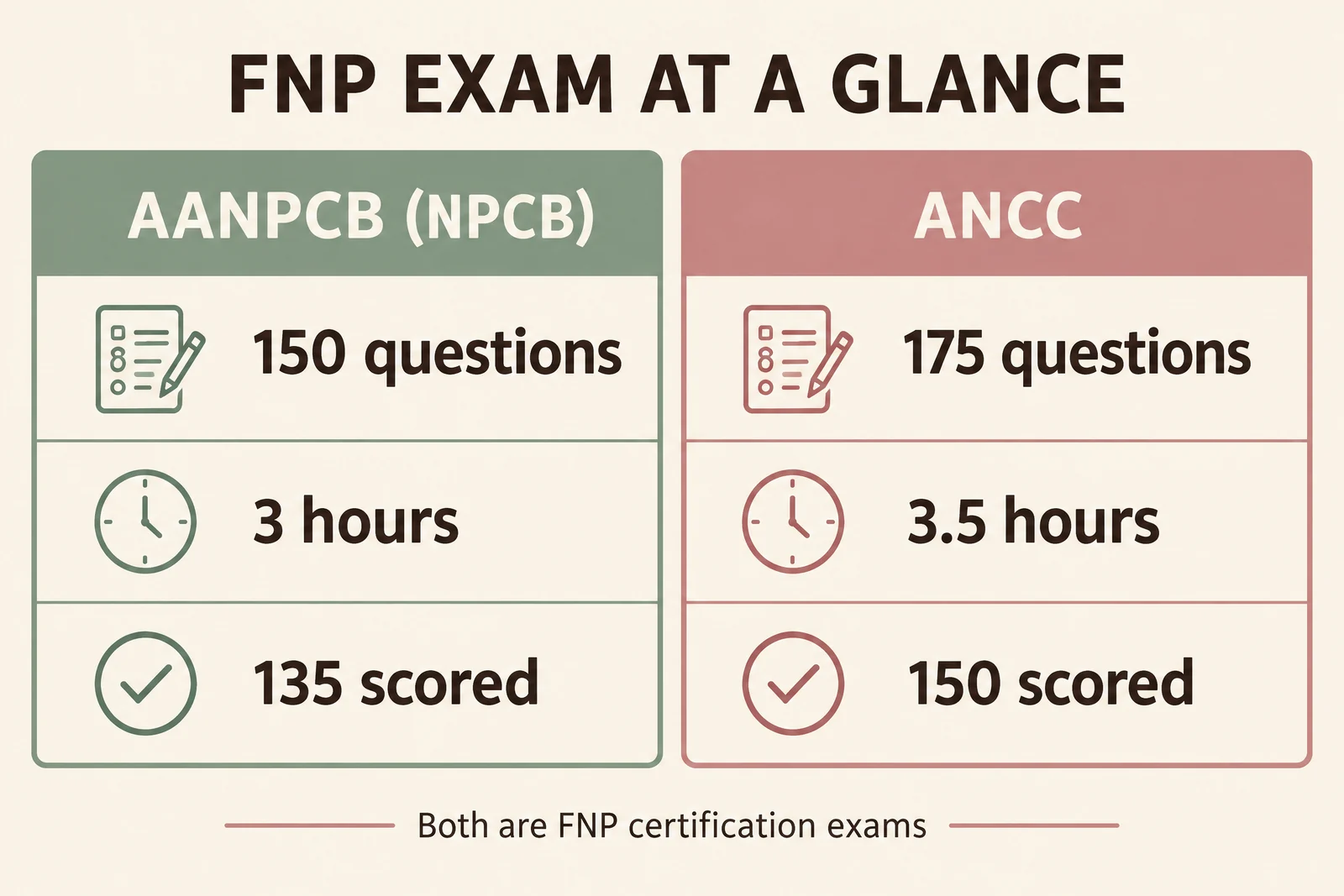
Figure 1. Exam length and scored-item counts, from the certifying bodies' 2026 publications; both pathways require meeting their eligibility rules.
What each outline actually tests
NPCB: Its current FNP outline distributes 135 scored items across Assess (43), Diagnose (36), Plan (36), and Evaluate (20). It emphasizes clinical decision-making across the lifespan. Yet it also lists evidence-informed practice, population health, healthcare economics, legal and ethical issues, and interprofessional practice in its knowledge areas. It is not accurate to promise that choosing NPCB means avoiding every policy, ethics, or systems question.
ANCC: Its FNP-BC outline for tests through October 18 has 150 scored items across Assessment (29), Diagnosis (26), Planning (29), Implementation (43), and Evaluation (23). Its new outline effective October 30 retains five domains but changes their weights: Assessment 26, Diagnosis 25, Planning 29, Implementation 50, Evaluation 20. Implementation includes patient-specific education, documentation, clinical interventions, regulatory and legal/ethical considerations, and responsible use of health technology. ANCC also tests clinical practice: it is not simply an exam about nursing theory.
October 2026 scheduling alert: ANCC says it will suspend testing during the outline change. Its FNP page says candidates may test before October 18 or after October 30. If your proposed date is close to that window, confirm availability with ANCC and Prometric directly; do not build a plan around an unconfirmed appointment. Study from the official outline that applies to your scheduled exam date, not a prep site's undated summary.
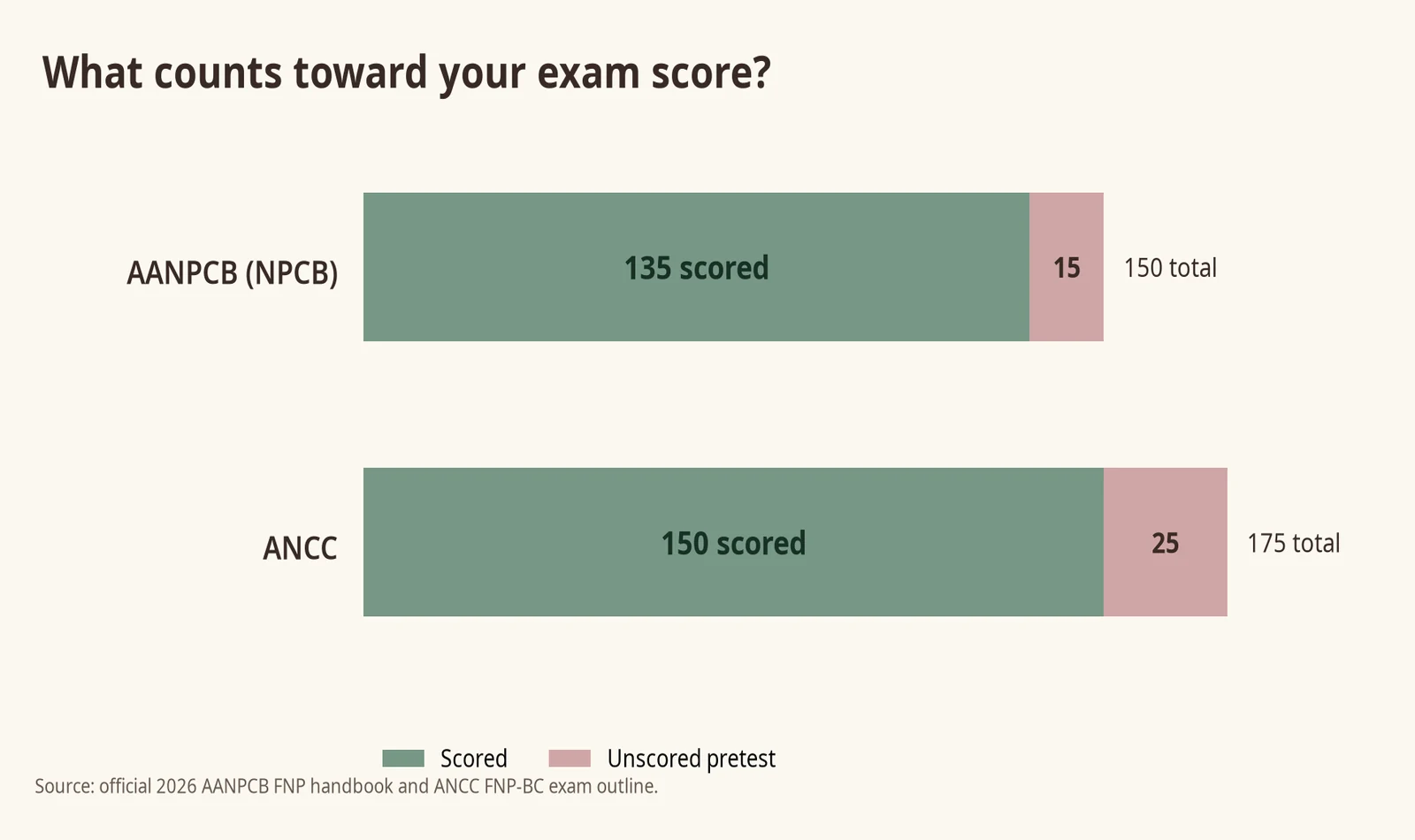
Figure 2. The pretest items are mixed into each exam and do not count toward your score; answer every question. Counts from the NPCB FNP handbook and ANCC FNP page. The larger number of ANCC scored items does not, by itself, show that its exam is harder.
A practical five-step way to decide

Figure 3. Compare the official outlines and your own requirements with a classmate or advisor before paying an exam fee.
- Check your eligibility with each board. Both specify an eligible FNP graduate program, an active RN license, and at least 500 supervised clinical hours; their detailed documentation and timing rules differ. NPCB handbook · ANCC eligibility. A review product cannot establish eligibility.
- Compare the outline that matches your test date. Mark each domain green (confident), amber (needs review), or rose (needs rebuilding). For ANCC, check the October 2026 transition first. Study what the board publishes rather than treating an informal "clinical vs theory" slogan as the entire blueprint.
- Practice the length and pacing. Simulate three hours/150 items for NPCB or 3.5 hours/175 for ANCC. Both official handbooks describe multiple-choice exams; popular claims that FNP-BC necessarily uses drag-and-drop or hotspot questions conflict with the current general ANCC handbook. Use the official ANCC FNP samples and ask ANCC about any format concern before making it decisive.
- Verify the real-world requirement. If a school, target employer, payer, or state licensing board specifies a certifier, ask it directly and keep the written answer. Avoid blanket claims that all VA, academic, or outpatient jobs prefer one credential: actual postings and jurisdictional rules vary.
- Compare total effort, not only the first fee. Consider your eligible discount, the published renewal pathway, scheduling availability, and the study materials you already own. Then choose one primary exam and use its outline to organize your prep. You can explore both certifications later if you have a concrete reason; most students need not pay for both immediately.
An example, not a universal rule: If your program and practice questions have trained you strongly on the NPCB domains and its available appointments fit your timeline, NPCB may be the cleaner first choice. If your plan specifically calls for FNP-BC or the ANCC outline and available appointment fit better, ANCC may be the better fit. Neither credential alone substitutes for licensure or makes you automatically more competitive for every role.
How renewal should affect the choice
Both credentials are valid for five years, but you should understand what maintaining each one entails before registering. Under the 2026 NPCB FNP renewal handbook, the practice-and-CE pathway requires 1,000 FNP practice hours and 100 advanced-practice CE hours, including 25 advanced-pharmacology hours, in the five-year period. An approved renewal by examination pathway is also described. Under the ANCC renewal handbook, FNP-BC renewal requires 75 CE hours, including 25 pharmacology hours, plus one complete eligible professional-development category; practice hours are one possible category, not universally mandatory. Requirements and fees can change by renewal time, so keep records and recheck the applicable handbook then.
Your registration-to-study checklist
- Save the NPCB FNP handbook and blueprint or the ANCC FNP page and dated test outlines.
- Confirm your program's accreditation, clinical-hour documentation, current RN license, transcript process, and the name on your testing ID.
- Check the board's authorization-to-test and appointment window. NPCB describes a 120-day eligibility window; ANCC also describes testing within a 120-day window, subject to approval and appointment availability. NPCB process · ANCC process.
- Schedule only once your approval and date are confirmed, and download the applicable exam outline again before your final review block.
- Build a weekly plan around weak domains; use timed questions and review the rationale for both the right and wrong answers. If you want a starting diagnostic, try The FNP Review's free practice exam. It is a study resource, not an official certifying-board exam or prediction of your certification outcome.
Frequently asked questions
Is AANP the same as AANPCB or NPCB?
No. AANP is a professional association; AANPCB is the certification board and now operates as NPCB. The NPCB FNP exam is often called the "AANP exam" informally. Its credential is NP-C with the FNP population focus. NPCB handbook.
Is ANCC harder than AANPCB?
There is no fair universal answer based on question count or unadjusted pass-rate percentages. The two exams have different blueprints and candidate populations. Do not choose solely from a third-party "easier exam" claim; use your own performance on outline-aligned practice and the appointment/credential requirements that matter to you.
Does either exam make me an FNP without state licensure?
Passing an exam can earn national certification once all certifier requirements are met. State APRN licensure is a separate process with its own requirements. Ask the state board where you plan to practice which certifications and documents it accepts.
What if I test near the ANCC October 2026 outline change?
Use the outline tied to your confirmed ANCC testing date: the existing outline for tests on or before October 18, or the new outline for tests on or after October 30, according to ANCC's current FNP notice. Verify any proposed date during the transition directly with ANCC/Prometric.
Ready to make a study plan?
Start with the official blueprint, then choose practice that explains why each answer is right or wrong. Explore the FNP board-prep path, the FNP QBank, or the free FNP practice exam. Our prep is independent; no review course is required by either certifying body or guarantees certification. For a more personal starting point, take the free AANP vs ANCC choice quiz.