AANP vs. ANCC for 2027: Which FNP Exam Should You Take?
Board Prep · 14 min read · November 27, 2026
Short answer: Neither exam is the universal winner. For graduating FNP students and new grads comparing AANP vs. ANCC for 2027, choose the certification that meets your eligibility, state licensure and employer requirements, then compare the current outline, exam length and total cost. NPCB/AANPCB offers a shorter exam and lower standard initial fee. ANCC may be the better choice when a position specifies FNP-BC or its published tasks fit your preparation.
Facts checked November 27, 2026. This guide uses current official materials as a baseline for testing in 2027—not a separately announced “2027 blueprint.” Verify the rules applicable to your actual exam date. The ANCC outline effective October 30, 2026 is already active. 1 3 4 6
Disclosure: The FNP Review sells educational review materials. This comparison is not a certifying-board endorsement or firsthand account of taking both exams.
A decision guide for 2027 candidates, based on official information checked November 27, 2026.
AANP vs. ANCC FNP exam: quick comparison
| Feature | NPCB/AANPCB, commonly called the “AANP exam” | ANCC |
|---|---|---|
| FNP credential | FNP-C | FNP-BC |
| Questions and examination time | 150 total: 135 scored + 15 unscored pretest; 3 hours | 175 total: 150 scored + 25 unscored pretest; 3.5 hours |
| Current question format | Computer-based multiple choice | Computer-based multiple choice |
| Domains and professional topics | Assess, Diagnose, Plan, Evaluate; professional issues included in applied knowledge | Assessment, Diagnosis, Planning, Implementation, Evaluation; professional responsibilities embedded across domains |
| Current initial online fees | $315 nonmember; $240 eligible AANP member | $395 nonmember; $295 eligible ANA member; other discounts below |
| Population focus | Family/individual care across the lifespan | Family care across the lifespan |
| Broad renewal cycle | Five years; board-specific maintenance requirements | Five years; board-specific maintenance requirements |
| Practical fit | Candidate who meets requirements and prioritizes a shorter exam or lower current standard fee | Candidate needing FNP-BC or preferring the published domain/task structure |
Sources: current board handbooks, outlines and fee schedules. 1 2 3 4 5 6 10 Fees are not guaranteed for future 2027 applications; membership costs are additional.
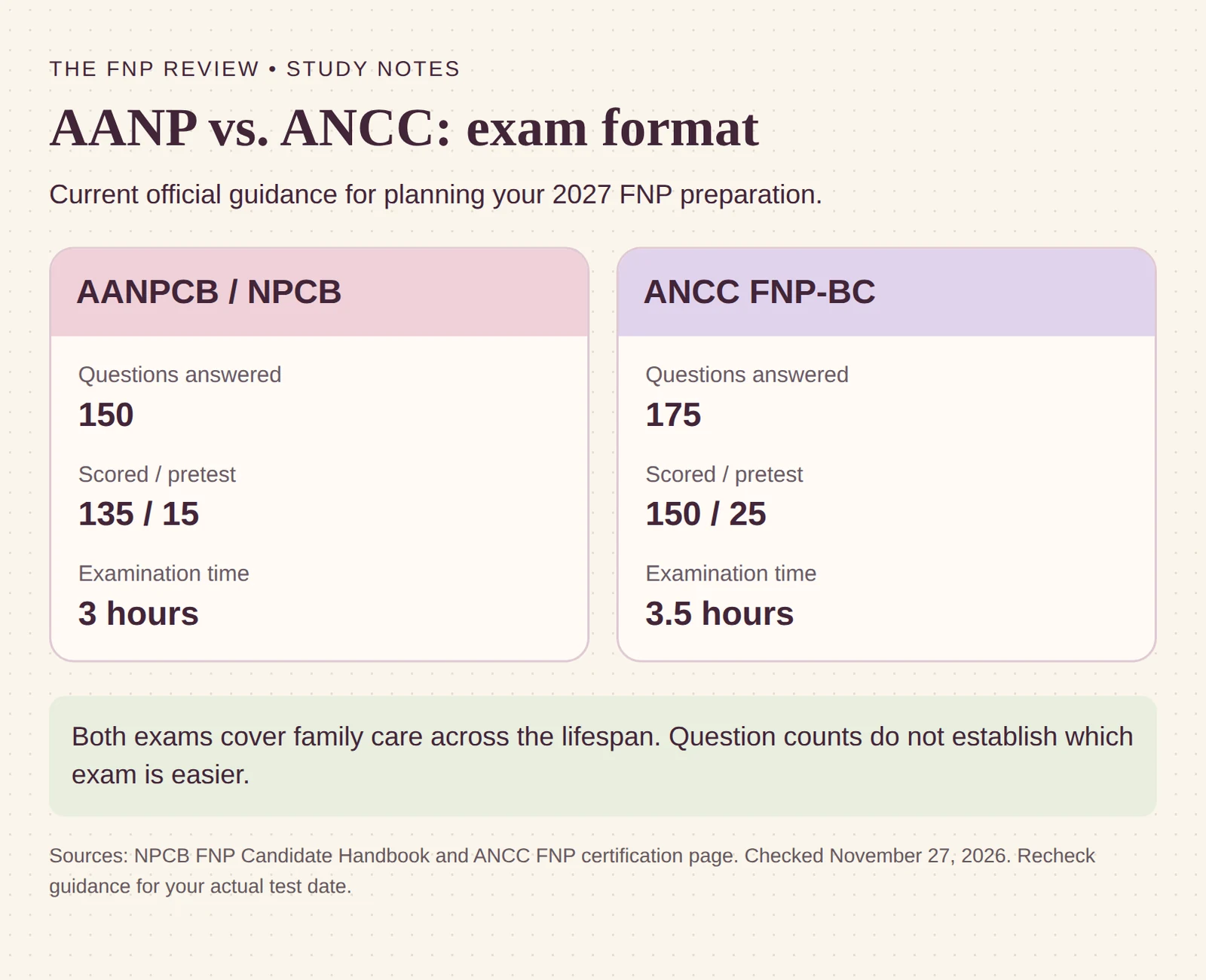
NPCB has fewer questions and a shorter examination period. Those differences do not establish that it is easier.
What do AANP, AANPCB and NPCB mean?
The current handbook identifies the American Academy of Nurse Practitioners Certification Board (AANPCB) as doing business as Nurse Practitioners Certification Board (NPCB). This is the board behind the exam often called “AANP.” It is separate from the American Association of Nurse Practitioners, the AANP membership association. NPCB is not an additional third FNP exam, and association membership is not required for certification. 1
ANCC is the American Nurses Credentialing Center. Its FNP credential is FNP-BC; NPCB's FNP-specific credential is FNP-C. 2 3
For a broader overview, see our general AANP vs. ANCC comparison. Here, the focus is current requirements and preparation decisions for a 2027 application.
Exam format and content: what actually differs?
Questions, time and pacing
NPCB gives you three hours for 150 multiple-choice questions, including 15 unscored pretest items. ANCC gives you 3.5 hours for 175 questions, including 25 unscored pretest items. Examination time is not the entire testing-center appointment; allow for the testing provider's check-in instructions. 1 3 4
ANCC states that pretest questions cannot be distinguished from scored questions. Treat every question as worth your attention rather than trying to identify experimental items. 4
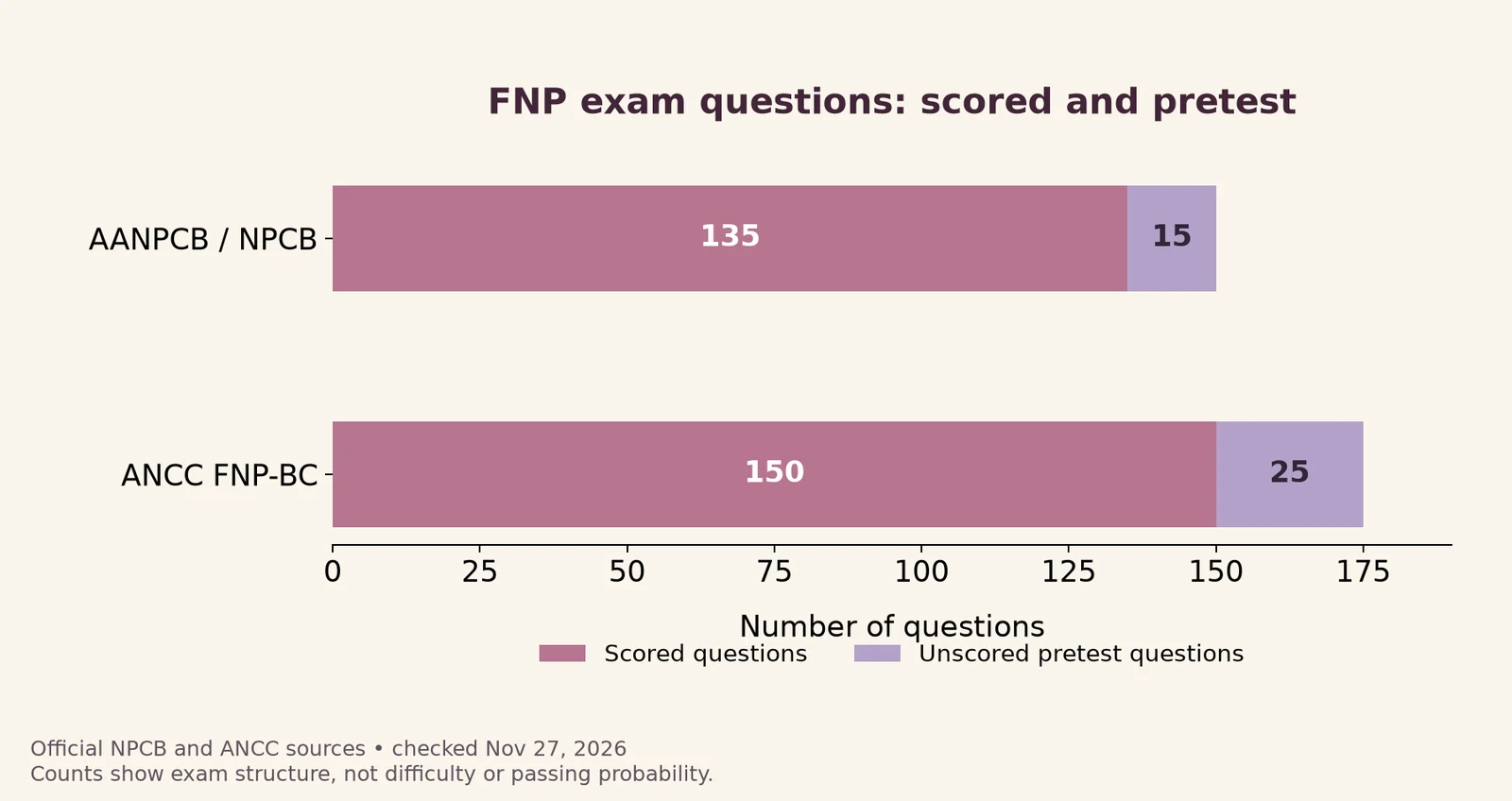
NPCB: 135 scored and 15 pretest questions. ANCC: 150 scored and 25 pretest questions. Pretest items are included in the total, not added afterward.
The current ANCC Certification Handbook describes multiple-choice examinations. Older comparisons that confidently list hot-spot, drag-and-drop or select-all-that-apply formats should not replace the currently published guidance. Both boards currently describe a multiple-choice format. 1 5
Current domain weights
Use the selected board's outline to organize review—not a social-media summary of “clinical versus nonclinical.”
NPCB's current scored domains: 6
- Assess: 43 questions, 32%; Diagnose: 36 questions, 26.5%.
- Plan: 36 questions, 26.5%; Evaluate: 20 questions, 15%.
The live page supplies these percentages. The June 2026 handbook rounds Diagnose and Plan to 27% each; that rounding difference is not evidence of a new exam. 1 6
ANCC's outline effective October 30, 2026: 4
- Assessment: 26 questions, 17%; Diagnosis: 25 questions, 17%.
- Planning: 29 questions, 19%; Implementation: 50 questions, 33%.
- Evaluation: 20 questions, 13%.
ANCC notes that its displayed percentages do not total 100 because of rounding. These allocations describe scored questions, not pretest questions. 4
Neither exam is “clinical only” versus “professional only”
NPCB includes healthcare economics, interprofessional practice, legal and ethical issues, population health, social drivers of health and cultural responsiveness in its applied knowledge areas. 1 6
ANCC has no separate Professional Role domain in its current outline. Responsibilities appear within the five domains: research appraisal in Planning; regulatory guidelines, scope and standards, documentation and responsible information-technology use—including AI—in Implementation; and ethical/legal principles in Evaluation. 4
Crucially, 33% Implementation does not mean 33% nonclinical questions. Implementation also includes clinical treatment, patient education and therapeutic communication. Prepare for the actual tasks listed, not an outdated category label. Both exams assess FNP care across the lifespan. 4 6
Eligibility: check your program before choosing your board
An MSN, postgraduate certificate or DNP can be a qualifying route, but the program, population focus, courses and documentation matter. A degree title alone does not establish eligibility.
NPCB/AANPCB requirements
NPCB requires completion of a graduate, postgraduate or doctoral FNP program accredited by a nursing accrediting organization recognized by the U.S. Department of Education or the Council for Higher Education Accreditation. Preparation must be in the nurse practitioner role and family/individual across-the-lifespan population focus. 1
You need a current, active RN license in the United States or a U.S. territory, maintained through certification, plus at least 500 faculty-supervised direct patient care clinical hours. Three separate graduate-level APRN core courses must cover advanced physical assessment, advanced pharmacology and advanced pathophysiology. 1 7
Assessment must include human systems and advanced techniques, concepts and approaches. Pharmacology must cover pharmacodynamics, pharmacokinetics and pharmacotherapeutics of all broad categories of agents; pathophysiology must cover general principles across the lifespan. 1
ANCC requirements
ANCC requires an FNP master's degree, postgraduate certificate or DNP from an institution with a program accredited by CCNE, ACEN or NLN CNEA. Effective January 1, 2026, postgraduate-certificate applicants need accreditation of the PGC APRN program itself, active at graduation; a parallel accredited master's or DNP track cannot substitute. 3 8
ANCC requires a current, active RN license in a U.S. state or territory, or the professional, legally recognized equivalent in another country. It also requires 500 faculty-supervised, role/population-specific clinical hours within the FNP program and three separate comprehensive graduate APRN courses: advanced physiology/pathophysiology across the lifespan; advanced health assessment covering all human systems and advanced techniques, concepts and approaches; and advanced pharmacology covering pharmacodynamics, pharmacokinetics and pharmacotherapeutics of all broad categories of agents. 3
Program content must include health promotion and/or maintenance, differential diagnosis and disease management, including prescription and use of pharmacologic and nonpharmacologic interventions. 3 8
Do not confuse the 750-hour educational standard with certification eligibility: the current ANCC FNP certification minimum remains 500 faculty-supervised hours. Work experience cannot replace those program hours. ANCC requires clinical-hours documentation and a completed Validation of Education form; NPCB's FAQ says it does not require that form, without waiving its clinical minimum. 1 7 8
Another ANCC policy effective January 1, 2026 requires initial and retest applications within five years of the applicable APRN degree or certificate conferral date. The deadline concerns application submission, not the test date or renewal. 9
Applying, testing and becoming certified are different
Both boards permit some pre-conferral testing after required coursework, clinical hours and other eligibility conditions are satisfied. Neither releases certification merely because you passed before graduation: final, degree-conferred official transcripts remain necessary. Ask your program about the correct documents before scheduling around a job start date. 1 3 8
FNP exam fees: compare your actual eligibility for discounts
The current initial online application fees favor NPCB at the standard nonmember rate, but compare the category you actually qualify for: 3 7 10
- NPCB: $315 nonmember or $240 eligible AANP member. The FNP discount is for AANP membership; the AAENP discount applies to ENP, not FNP.
- ANCC: $395 nonmember; $295 eligible ANA member; $340 AANP member; $290 AANP student member; $340 GAPNA member.
ANCC's ANA discount excludes e-membership. Its discounts cannot be combined, and listed prices include a $140 nonrefundable administrative fee; special-service charges may also apply. Membership costs are not included in either board's exam fee. 3
If membership information was omitted, NPCB's FAQ permits eligible applicants to email it within 30 days of application. ANCC permits claiming discounts up to five business days after it receives the application. Confirm current terms rather than assuming a later refund. 3 7
These are November 27, 2026 prices—not guaranteed 2027 fees. Budget separately for preparation, membership and any retesting.
Retakes, renewal and licensure are separate decisions
If you need to retest
NPCB's current FNP policy, effective January 2026, allows up to three attempts per calendar year, January 1–December 31. Its handbook permits reapplication after official score notification, with an application, payment and eligibility review. Its current FAQ also requires at least 15 CE hours for retesting; confirm the applicable CE conditions directly with the board. Do not assume an unverified waiting period. 1 7
ANCC requires 60 calendar days between test dates, with no more than three tests in any rolling 12-month period. Wait five days after the exam before submitting its online retest application; that submission instruction does not shorten the 60-day testing interval. 12
Board retake policies are different from commercial mock-exam attempt allowances. Buying additional practice materials does not change your certification attempt limit.
Renewal and permission to practice
Both certifications have a five-year renewal cycle, but not identical requirements. NPCB provides a practice-hours-plus-CE route or renewal by examination. ANCC uses mandatory CE plus selected professional-development activities; specialty practice hours are not a universal prerequisite in its framework. 2 8 11
ANCC has published a renewal handbook effective February 1, 2027. That is a renewal update, not a new FNP initial-exam outline. Use the rules applicable when renewing; today's details are not a promise about a first renewal around 2032.
Both are nationally recognized FNP certification options, but national certification is not state APRN licensure. Confirm your state board's requirements and the intended employer's credentialing rules. Neither passing an exam nor holding a credential alone authorizes practice or prescribing. 2 3 11
Which FNP certification exam should you take?
Choose NPCB/AANPCB if you meet its requirements, your state and employer accept FNP-C, and the shorter examination or lower current standard fee matters. Its four-domain outline gives you a clear framework for reviewing assessment, diagnosis, planning and evaluation. Still prepare for its listed professional issues.
Choose ANCC if a specific employer requires FNP-BC, or its published domains and implementation tasks give you a stronger preparation fit. That fit should come from reviewing the outline and your gaps—not assuming ANCC is automatically required for academic, leadership or hospital jobs.
Pause before choosing either if your PGC accreditation is unclear, you are near ANCC's application time limit, or your transcript timeline could delay certification. Resolve an eligibility problem before spending on a board-specific study package.
If both options satisfy your requirements, compare cost and scheduling, then commit to one outline. Fewer questions do not prove easier content; a longer exam does not prove a better credential.
Turn the choice into a three-step FNP board study plan
1. Use the current outline as your checklist
Download the board's outline and check its effective date against your intended test date. Group your review by clinical systems while ensuring coverage of every published domain and professional task. Use the weights to prioritize—not to skip smaller domains. 4 6
2. Establish a closed-book baseline
Complete an initial question set without notes, then examine why answers were missed or guessed. Were you missing content, overlooking wording, or unable to explain the choice? Those categories can guide your next sessions; they are not a validated passing prediction.
Choose resources to address the gap. Our FNP board review materials guide for 2027 explains how to combine formats without buying overlapping tools.
3. Repeat recall, feedback and later review
Try an answer before opening the explanation, correct it, and return on another day. Retrieval practice and distributed practice have strong general learning support; a health-professions systematic review also found benefits across many experiments. That evidence does not establish a guaranteed FNP pass rate or universally sufficient preparation duration. 14 15

A manageable routine can combine brief recall sessions with focused question review. Photo: Jilly Noble / Pexels.
Match the tool to the activity:
- Book and Workbook: The 2027 FNP Book + Workbook pairs a printed visual review with guided recall exercises and scenarios. Read a section, close it, answer a prompt, then check. The standalone pair does not include digital QBank, exams, course or Planner. 17
- Course: Use the on-demand video course for guided explanations. Pause, hide slides and notes, and explain the key concepts from memory before replaying.
- QBank: In the FNP QBank, commit to an answer before revealing the rationale. Review wrong answers and correct guesses; write a short corrected explanation rather than copying the whole rationale. Corrective feedback matters. 16
- Physical cards: The 300 pharmacology cards suit short review windows. Answer before turning over a card, check the response and revisit it later—not merely flip through familiar prompts.
The Board Pass system is our best-fit recommendation for readers wanting course, QBank, practice exams, print materials and planning together—not the best purchase for everyone. Confirm current inclusions, access terms and activation steps at checkout. Permanent exam ownership does not mean unlimited mock attempts; 3P preparation is separate and not included. 18
Use the FNP Study Planner to organize a calendar around your exam date, available hours, all-day obligations and weak systems. Its plan progress reflects self-reported completion of marked-off study days and book tasks, not a validated probability of passing. Linked digital resources depend on access entitlements; a calendar is not proof of automatic enrollment. 19
For a worked routine, see the 30-day FNP active-recall study plan. Thirty days is a planning window, not a readiness guarantee.
Frequently asked questions
Is AANP or ANCC easier?
There is no supported universal difficulty winner in the evidence used here. NPCB is shorter, but the better choice depends on requirements, content gaps and preparation—not question count alone.
Is there a new AANP or ANCC exam for 2027?
The official materials checked November 27, 2026 did not establish a separately dated 2027 FNP initial-exam blueprint. ANCC's October 30, 2026 outline is already active; its February 2027 renewal handbook is a different document. 4 13
Does ANCC still use hot-spot or drag-and-drop questions?
The current ANCC handbook describes multiple-choice examinations. Do not rely on older format claims when preparing; consult current board and testing instructions. 5
Do both boards require 750 clinical hours?
No. The current certification minimum for each is 500 faculty-supervised hours, with board-specific conditions. ANCC distinguishes the 750-hour educational standard from its current exam eligibility minimum. 1 8
How much do the FNP exams cost?
Current initial online nonmember fees are $315 for NPCB and $395 for ANCC. Eligible member/student discounts differ, and membership costs are additional. Recheck fees before applying in 2027. 3 10
Do I need a DNP to take either FNP exam?
No. Eligible master's and postgraduate-certificate routes also exist. Confirm the board's accreditation, coursework, clinical-hour, RN-license and documentation requirements; ANCC additionally has its five-year application deadline. 1 3 9
Does passing either exam give me an APRN license?
No. Certification and state licensure are separate. Check the state board and employer before assuming either credential satisfies every requirement for your intended position. 2 11
How many times can I retake the exam?
NPCB allows three FNP attempts per calendar year under its current policy; ANCC allows three in any 12 months with a 60-day interval. NPCB's FAQ also specifies at least 15 CE hours; confirm conditions before reapplying. 7 12
Can I prepare for FNP boards in 30 days?
Some candidates may use a 30-day calendar, but it cannot establish that everyone has enough time. Start with your gaps, realistic hours and certification timeline. Extend the plan when needed rather than treating completed days as a pass prediction.
Bottom line
Choose the board that meets your requirements, then use its current outline to guide preparation. NPCB offers the shorter exam and lower current standard fee; ANCC offers FNP-BC and its own published task structure. Neither is universally easier or better. Once eligibility is confirmed, build a study calendar that protects time for answering from memory, checking feedback and returning to difficult concepts—not just consuming more material.
Save the tall Pinterest artwork for this guide.
References
- Official NPCB/AANPCB FNP Candidate Handbook, updated June 2026
- Official NPCB FNP Renewal Handbook, updated June 2026
- Official ANCC FNP-BC certification page: eligibility, fees, examination and linked documents
- Official ANCC FNP-BC Test Content Outline, effective October 30, 2026; updated April 6, 2026
- Official ANCC Certification Handbook, Version 5, October 12, 2026; multiple-choice format
- Official NPCB FNP examination page: live domain weights, lifespan and applied knowledge
- Official NPCB FAQs: licensure, documentation, discounts and current FNP retesting policy
- Official ANCC FAQs: accreditation, clinical hours, documentation and renewal
- Official ANCC five-year APRN application time-limit policy, effective January 1, 2026
- Official NPCB certification overview and browser-verified initial fee schedule
- Official currently linked ANCC Certification Renewal Handbook
- Official ANCC retest policy: 60-day interval and three tests in any 12 months
- Official ANCC Certification Renewal Handbook, effective February 1, 2027
- Dunlosky et al., 2013: Improving Students' Learning With Effective Learning Techniques
- Trumble et al., 2024: Systematic review of distributed practice and retrieval practice in health professions education
- Metcalfe, 2017: Learning from Errors
- The FNP Review official 2027 FNP Book + Workbook product page
- The FNP Review official Board Pass product page; confirm current checkout inclusions and terms
- The FNP Review FNP Study Planner; calendar and plan-progress descriptions based on same-day verified evidence